Moving heavy stackable chairs looks simple until the dolly bends, rolls poorly, or becomes unstable. In busy schools, banquet halls, and conference venues, chair handling often happens quickly. Floors may change from smooth concrete to carpet. Doorways may narrow without warning. A suitable dolly must handle these conditions safely and consistently.
So, what type of dolly is best for moving heavy stackable chairs? The answer depends on chair weight, stack height, frame shape, and daily usage. A heavy-duty chair dolly with a strong steel frame usually offers dependable support. Large swivel casters can improve movement around tables and tight corners. Pneumatic or non-marking wheels may protect floors while reducing vibration. Check the manufacturer’s load rating carefully. Do not judge capacity by appearance alone.
Small details matter.
A reliable design should hold chairs upright without excessive shifting. Adjustable supports can fit different chair widths. A handle with comfortable grip reduces strain during repeated trips. Safety straps may help control tall stacks, especially on ramps or uneven surfaces. Still, no dolly works perfectly everywhere. I have seen sturdy models struggle when stacks were too high or poorly balanced. That mistake is easy to repeat.
Measure your storage path before purchasing. Test the dolly with a realistic chair stack, not one empty chair. Listen for rattling. Watch the wheels. If the frame twists, reconsider the model. The best choice combines proven capacity, smooth handling, floor protection, and practical fit for your facility. Safety should guide the decision, even when speed feels more important.
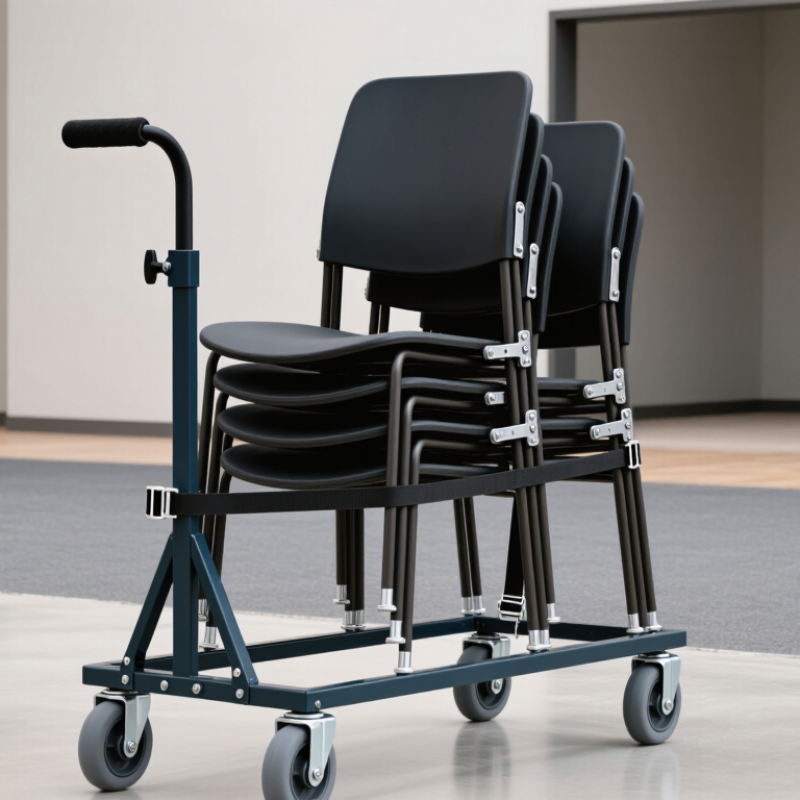
Choosing a dolly for heavy stackable chairs begins with a clear load definition. Measure one chair, then weigh it instead of trusting catalog estimates. Multiply the actual chair weight by the planned stack height. A stack of 12 chairs at 18 pounds each weighs 216 pounds. That figure excludes the dolly, straps, and sudden movement.
Add a 25% safety margin before selecting capacity. In this example, 216 pounds becomes 270 pounds. Choose a dolly rated above that working load, not exactly at it. Capacity should also reflect uneven floors, doorway thresholds, and braking forces. A tall stack can shift, even when its total weight seems acceptable. Measure the stack’s height and width, then check clearance through doors and storage racks. Keep the center of gravity low whenever possible.
In field use, four sturdy casters often roll smoothly, but small wheels struggle over floor joints. Wheel diameter, frame width, and handle height deserve equal attention. Secure the chairs with a strap without crushing fragile frames. Test one loaded dolly first. Walk it slowly, stop, turn, and inspect movement.
This method is practical, though not flawless. Chair shapes vary, and the calculated margin may need adjustment after real testing. Record the result for future loads. A simple label showing maximum stack height can prevent rushed decisions.
A suitable dolly must support the chairs safely, not merely move them. Check the chair’s weight, width, frame shape, and maximum stack height. A narrow platform can leave chair legs hanging over the edge. That creates wobbling during turns.
ANSI/BIFMA X5.1 includes a 275-pound static load test for office chairs. It does not certify every chair dolly or prove transport safety. However, it offers a useful reference for evaluating chair strength and compatibility. Confirm that the chair can withstand this load before stacking several units. Then compare the dolly’s rated capacity with the combined chair weight. Include the operator’s pushing force and uneven floors. Real handling is less tidy than a test room. That matters.
Tips:
Measure the chair frame at its widest point.
Check stack height under doorways and storage racks.
Choose wheels suited to the floor surface.
Locking straps can reduce shifting, but they should not crush the chair frame.
Inspect welds, wheels, handles, and fasteners before use.
A rating label may look convincing, yet the platform can still flex.
Test a small stack first.
Recheck it after several movements.
Safety checks are sometimes imperfect, and that is exactly why they should be repeated.
Choosing a dolly for heavy stackable chairs starts with the real moving load. Count every chair, the dolly frame, straps, and any attached hardware. Do not rely on the chair’s listed weight alone. For example, 24 chairs at 8 pounds each, plus a 30-pound frame, create 222 pounds. Divide that total by three, not four, because uneven floors can leave one caster carrying little weight. Each caster should therefore support at least 74 pounds before adding a safety margin. A 100-pound-rated caster would be a more practical choice.
This method reflects common material-handling practice. The NIOSH Revised Lifting Equation uses a 51-pound load constant, then reduces it for reach, height, twisting, frequency, and grip conditions. Dolly movement has similar variables, including starting force and floor joints. The U.S. Bureau of Labor Statistics’ 2023 Injuries, Illnesses, and Fatalities data still identifies overexertion and bodily reaction as major causes of days-away-from-work cases. Smooth, correctly sized casters can reduce pushing effort, but they cannot repair an overloaded frame. I have seen four-wheel dollies wobble when one wheel crosses a doorway lip. The divide-by-three rule is conservative, though imperfect. Recheck the calculation if chairs are unevenly stacked or the route includes ramps, thresholds, or outdoor pavement. Larger wheels usually cross floor gaps better, but they may raise the load height and make the dolly harder to control.
Use the actual chair weight whenever possible. The planning examples below include the dolly frame and show why caster capacity should be based on total loaded weight divided by three when four casters may not share the load evenly on an uneven floor.
| Example | Chairs per Dolly | Average Chair Weight (kg) | Dolly Weight (kg) | Total Loaded Weight (kg) | Uneven-Floor Design Load (Total ÷ 3) |
Minimum Rated Capacity per Caster (kg) | Suggested Caster Diameter | Recommended Floor Type | Useful Caster Features | Selection Result |
|---|---|---|---|---|---|---|---|---|---|---|
| A | 12 | 11.0 | 18 | 150 | 50.0 | 60 | 100 mm | Smooth indoor floors | Swivel action; two brakes | Use four casters rated at least 60 kg each |
| B | 24 | 11.5 | 22 | 298 | 99.3 | 125 | 125 mm | Indoor floors with small joints | Swivel action; polyurethane tread; two brakes | Use four casters rated at least 125 kg each |
| C | 36 | 12.0 | 26 | 458 | 152.7 | 200 | 125–160 mm | Uneven concrete or tiled floors | Larger wheel; sealed bearings; two brakes | Use four casters rated at least 200 kg each |
| D | 48 | 12.5 | 32 | 632 | 210.7 | 250 | 160 mm | Rough or frequently traversed floors | Heavy-duty swivel plate; polyurethane or rubber tread; brakes | Use four casters rated at least 250 kg each |
Calculation method: Total loaded weight = (number of chairs × average chair weight) + dolly weight. Minimum uneven-floor capacity per caster = total loaded weight ÷ 3. Always round up to the next available caster rating.
How to Choose the Best Dolly for Heavy Stackable Chairs?
A chair dolly must move more than a simple load. It carries uneven weight, narrow aisles, and changing floor surfaces. For most heavy stackable chairs, choose casters measuring 100–125 mm in diameter. This range helps the wheels pass over door thresholds and floor joints with less jolting. Larger wheels usually roll more smoothly, but they can raise the dolly and affect loading height. Check the clearance beneath the lowest chair frame before purchasing.
A practical test matters more than a specification sheet. Load the dolly with the exact chair quantity used in your facility. Push it across tile, carpet, and a 10–15 mm threshold. The handle should remain stable, and the casters should swivel without scraping. I once selected wheels that looked strong but felt awkward in a tight storage room. The mistake was focusing on load capacity alone. Choose casters with a suitable combined load rating, smooth swivel action, and brakes that engage firmly.
Tips: Measure your narrowest doorway first. Test the loaded dolly, not an empty one. Pneumatic wheels may absorb bumps, but they need maintenance and can feel less precise indoors. Solid rubber or polyurethane wheels often steer more predictably on finished floors. Keep the heaviest chairs low and centered. A slightly smaller load may move better than an overloaded dolly. Check caster alignment regularly, because one dragging wheel can make steering surprisingly difficult.
A heavy-chair dolly should be tested with the real chair stack, not an empty frame. I have seen a smooth-looking dolly become unstable after several loaded turns. Check the brakes on polished and uneven floors. They should engage quickly and release without foot strain. A brake that requires repeated force may increase fatigue during long setup days. Retainers matter just as much. They should hold chairs firmly without scraping paint, trapping fingers, or loosening under vibration. Confirm that the retainer fits your chair shape, not only the advertised capacity.
Ergonomics deserves attention before comparing ownership cost. Measure handle height against the main users. Push handles should support a neutral wrist position and clear the stacked chairs. Large swivel casters can reduce effort, but they may feel unpredictable on tight corners. Test turning, stopping, and reversing in a crowded storage area. Record the effort required. My first evaluation missed doorway clearance, which caused unnecessary repositioning. That mistake was small, but repeated daily.
Tips: Load the dolly fully during testing. Push it over thresholds. Check brake access while wearing work gloves. Inspect welds, wheels, fasteners, and retainer padding. Estimate replacement parts, cleaning time, and staff effort over one year. A cheaper dolly may cost more when wheels wear quickly or brakes need frequent adjustment. Keep written test notes. Memory is unreliable. The best choice is not always the lowest purchase price.
Weigh one chair and multiply its weight by the planned stack height. Add the dolly, straps, and attached hardware. Then add a 25% safety margin. Do not choose a rating that only matches the calculation. Real movement is less predictable.
The chairs weigh 216 pounds together. A 25% margin raises the working load to 270 pounds. Choose a dolly rated above 270 pounds. This excludes sudden stops, thresholds, and uneven flooring. Leave room.
Follow the chair maker’s stated maximum stack height when available. Measure the actual stack before moving it. Check doorways, storage racks, and ceiling clearance. A tall stack can shift during turns. Keep the center of gravity low.
Add the chairs, dolly frame, straps, and hardware. Divide the total load by three for uneven floor loading. For example, 222 pounds requires at least 74 pounds per caster. A 100-pound-rated caster gives more practical reserve. The rule is conservative, not perfect.
Larger wheels usually cross floor joints and doorway lips more smoothly. Small wheels may catch suddenly. However, larger wheels can raise the load height. That may make the dolly harder to control. Test the route.
Use a strap that holds the stack without crushing chair frames. Keep chair legs inside the platform edges. A narrow platform can cause wobbling during turns. Inspect the strap after stopping and turning. Shifting still happens.
No. A static test only offers a useful chair-strength reference. It does not prove transport safety or certify a dolly. Compare the chair’s strength with the combined moving load. Uneven floors and pushing forces create different stresses. Static is not motion.
Check welds, wheels, handles, fasteners, straps, and the platform. Look for flexing, loose parts, or damaged caster mounts. Test one small stack first. Walk slowly, stop, turn, and inspect movement again. Record what worked. Reconsider weak points.
Use both hands and move slowly through thresholds and tight turns. Plan the route before loading chairs. Avoid sudden braking and sharp steering. Pushing effort increases with heavy loads and poor floors. The calculation may need adjustment after real use.
Choosing the right equipment begins with defining the real load. Calculate the combined weight of the dolly and chairs, account for the planned stack height, and add a 25% safety margin for dependable handling. Confirm that the chair configuration and support points are suitable for the static performance expectations associated with ANSI/BIFMA X5.1, including its 275-pound static test reference. This helps ensure the dolly can support the intended load without unnecessary flexing or instability.
When deciding what type of dolly is best for moving heavy stackable chairs, size the casters using the total loaded weight divided by three to account for uneven floors and shifting pressure. Casters around 100–125 mm generally provide a useful balance of threshold clearance, maneuverability, and steering effort. Before comparing long-term ownership costs, also inspect the brakes, chair retainers, frame ergonomics, and loading height. A reliable dolly should secure stacked chairs, remain easy to control, and reduce strain during repeated movement.

Zabs Furniture