Choosing foam for church auditorium seats is more than selecting the firmest cushion. Density affects comfort, shape retention, durability, and long-term seating quality. In a busy sanctuary, a seat may support children, adults, and elderly worshippers throughout the week. It must feel supportive without becoming hard. It should also recover after repeated use.
This guide explains how to choose the right foam density for church auditorium seats through practical seating experience and material knowledge. Foam density measures the material’s weight per volume, not simply its softness. A higher-density foam usually offers better durability, while firmness depends on the foam’s compression rating. These properties should be evaluated together.
For many church projects, medium to high-density polyurethane foam provides a useful balance. However, the best specification depends on seat design, user frequency, climate, frame construction, and maintenance routines. A quiet chapel may need different foam than a large auditorium hosting several services each day. Small details matter, including cushion thickness and fabric tension.
We have seen attractive seats lose comfort because density was chosen from a catalogue alone. That approach is incomplete. Samples should be tested in the actual seat structure, preferably with different body weights and sitting durations. A density chart cannot predict every experience. Recommendations may still require adjustment. Careful testing remains the most reliable path toward comfortable, durable, and responsible church seating.
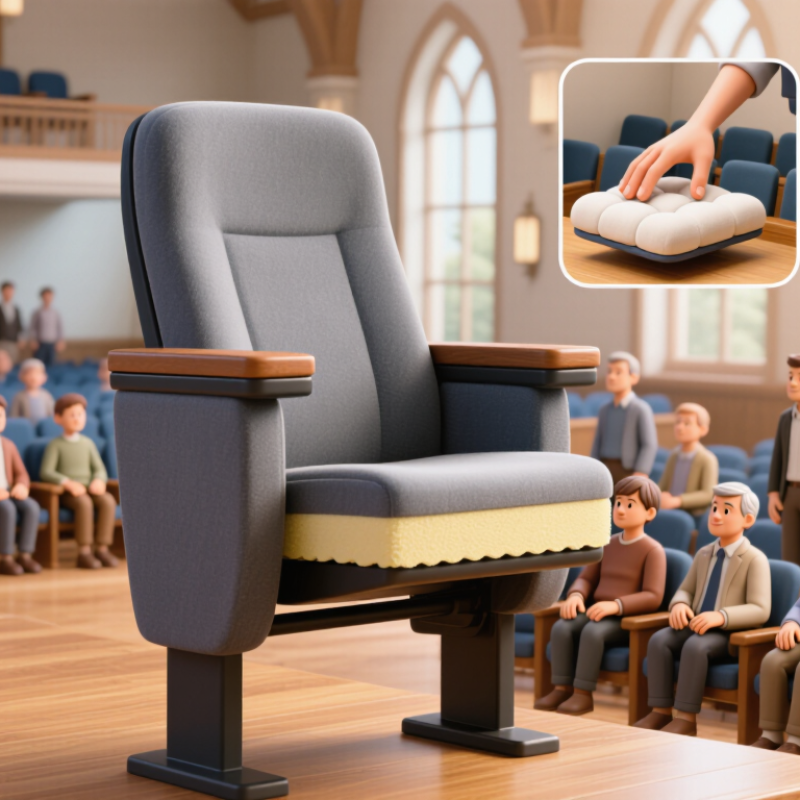
Foam density strongly affects how church seats feel and perform over time. It describes the foam’s weight per cubic meter, not its firmness. Higher density usually provides better durability and slower compression. However, dense foam can still feel too hard without the right firmness rating.
For church seating, many projects consider foam around 35–45 kg/m³, depending on cushion thickness and expected use. The best choice depends on service length, visitor traffic, frame support, and upholstery material. A thin cushion may need more resilient foam to prevent users from feeling the wooden base. A thick cushion can distribute pressure more gently.
Seat testing gives useful evidence. Ask several people to sit for 30–60 minutes. Check pressure under the thighs, hips, and lower back. Watch how quickly the cushion regains its shape after standing. Comfort should remain stable during long sermons, not only during a brief showroom test. I once focused too much on density and overlooked seat angle. That was a mistake. Density alone cannot create comfort.
Firmness, resilience, and foam thickness must work together. A softer cushion may welcome short visits but flatten sooner under daily use. A firmer cushion may support larger users, yet feel tiring for children or older adults. Measure real conditions carefully. Then compare samples under realistic church use, because the most expensive foam is not always the most suitable.
Density measures foam weight per cubic meter. It does not directly measure softness or comfort. A higher number is not automatically better.
Occasional services may suit medium-density foam. Daily services, children’s programs, and meetings need stronger support. Repeated use increases compression and fatigue.
Medium-firm foam often balances comfort and posture during extended sitting. Very soft foam may bottom out. Very firm foam can pressure the thighs.
No. Density must match thickness, expected use, and maintenance. A high-density cushion can still sag if the frame or upholstery is unsuitable.
High-density polyurethane foam can support frequent use. Molded foam may fit curved seat pans consistently. Rebonded foam feels firm and may work better as a support layer.
Test samples on the actual wooden seat base. Include different body sizes. Sit for thirty minutes, then check recovery and edge support.
Request density, firmness, recovery, compression results, and expected service life. Ask for sample cuts. Compare samples at the same thickness.
Yes. Humid halls may need moisture-resistant construction and ventilation. Cleaning methods also matter. Local conditions can expose weaknesses that showroom tests miss.
Inspect a sample after repeated loading or several weeks of use. Record occupancy, temperature, and cleaning routines. A short showroom test is not enough.
Exact requirements remain uncertain without measuring real use. A practical trial often reveals more than a confident specification. That limitation matters.
Choosing the right foam density for church auditorium seats requires balancing comfort, support, durability, and budget. Foam density refers to the material’s weight and structure, while firmness describes how the seat feels when used. To understand how to choose the right foam density for church auditorium seats, consider service frequency, average user weight, sitting duration, and whether the seating is used daily or only during weekly services. Higher-density foam generally provides better resilience and a longer service life, while medium-density foam may offer a comfortable and economical solution for lighter or less frequent use.
The seat design also matters. Upholstered chairs, folding seats, pew cushions, and stackable seating may require different foam characteristics. Compare foam types for pressure relief, recovery, ventilation, and resistance to flattening. Before purchasing, check product consistency, fire and safety documentation, environmental considerations, and supplier quality standards. Testing sample cushions under realistic conditions can help confirm comfort and performance, ensuring the final choice supports worshippers effectively over many years.

 Zabs Furniture